
'Once the market decides it wants to go up, it goes up -- no amount of bad news can really hold it back.'

'Once the currency goes out of the hand, then possibly your major challenge is that it will not come back.'

The woman who confronted BJP workers during a protest in Mumbai's Worli area last month has criticised all political parties for disregarding the general public.

Gold imports climbed 349.22 per cent to $12.07 billion in January, while silver imports rose 127 per cent to $2 billion.
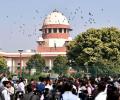
The Supreme Court of India has ruled that no timelines can be imposed on governors and the president to grant assent to bills passed by state assemblies, clarifying the extent of their powers under Article 200 of the Constitution.
'At the first sign of real trouble, that money will move. There will be a run.'

'All this talk about women's reservation and Nari Shakti is a mirage.' 'It is a classic Trojan horse to bring about an alteration in the structure of political competition -- to the enduring advantage of the BJP.'

Parliamentary Affairs Minister Sushma Swaraj said the government was open to supporting an amended or an altogether new bill if unanimity was not possible on the legislation in its present form.

Petrol and diesel prices have been increased by Rs 3 per litre each, marking the first hike in over four years, as state-run fuel retailers pass on some of the impact from surging global crude prices, which have been exacerbated by the Iran war.

The high-intensity election campaign in Tamil Nadu concluded with accusations and counter-accusations between the DMK and AIADMK, while new entrant TVK made its presence felt. Key issues included state autonomy, corruption, law and order, and the delimitation bill.

West Bengal's new government, led by Chief Minister Suvendu Adhikari, has approved several key policy changes, including the implementation of the Ayushman Bharat health scheme, land transfer for border fencing, and the adoption of new criminal laws.

A special audit by the Comptroller and Auditor General (CAG) has revealed that Odisha's forest and environment department sidestepped central guidelines, procuring and customising Mahindra Thar SUVs worth 17 crore from the State Disaster Response Fund (SDRF) for forest protection, despite the funds being earmarked for 'preparedness and capacity building'.

The West Bengal government, led by Chief Minister Suvendu Adhikari, has announced the implementation of several key administrative and policy measures, including the adoption of the Ayushman Bharat health scheme, land transfer to the BSF for border fencing, and the implementation of the BNS criminal law.
The West Bengal government, led by Chief Minister Suvendu Adhikari, has announced the implementation of several key administrative and policy measures, including the adoption of the Ayushman Bharat health scheme, land transfer to the BSF for border fencing, and the implementation of the BNS criminal law.

Even if there is an early agreement on a cessation of hostilities in West Asia, the price shock will not go away easily, points out A K Bhattacharya.

IRCTC is expanding its payments arm, IRCTC Payments, to handle transactions across its ticketing platform and tap government clients, aiming to scale its annual payment processing to approximately 1 trillion.

If TVK MLAs and ministers are perceived as clean, or demonstrably cleaner than their predecessors, the credibility dividend will be enormous. The voter will feel rewarded, points out Ramesh Menon.

Union Home Minister Amit Shah accused West Bengal Chief Minister Mamata Banerjee of shielding infiltrators, promoting dynastic politics, and supporting the construction of a mosque resembling the Babri Masjid.

'First-time applicants may witness longer approval times or higher rejection rates and requests for more documentation.'
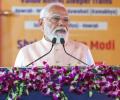
Prime Minister Narendra Modi has accused the Mamata Banerjee government of favouring infiltrators over the native population, asserting that the upcoming assembly election in West Bengal is a battle to save the state's identity.

Haryana Chief Minister Nayab Singh Saini commemorated B.R. Ambedkar's birth anniversary, highlighting his contributions to women's empowerment and social justice. Saini and Union Law Minister Arjun Ram Meghwal criticised the Congress party for allegedly disrespecting Ambedkar, while praising the current government's efforts to honour his legacy.

Maharashtra's Governor and Chief Minister, along with other state leaders, paid tribute to Dr. B.R. Ambedkar on his 135th birth anniversary, recognising his profound impact on social justice, equality, and the Indian Constitution.
Prime Minister expresses confidence that he will find support towards the move reserving 33 percent seats for women in parliament and state legislatures.
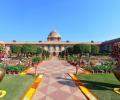
The Supreme Court has ruled that a Governor cannot send bills to the President for consideration if the state assembly has already cleared them for a second time. The court was questioning the Centre over the powers of the Governor when it comes to granting assent to bills.
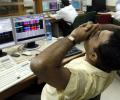
'We are profoundly energy-dependent on the Gulf. That dependency must now be redirected towards the United States, because we require American permission to procure oil.' 'We additionally require Iranian permission to acquire oil from that source. So India now has to seek two separate permissions merely to secure its energy supply.' 'Should we be compelled to source from America, or from Venezuela -- which is, in effect, American-controlled supply -- that will inevitably carry a price premium, an elevated shipping cost, and a considerably extended delivery timeline, given the distances involved.'

The Reserve Bank of India (RBI) has unveiled draft norms for branch authorisation and business correspondents (BCs), introducing a two-tiered classification for BCs and redefining 'banking outlets' to include BC-Banking Outlets (BC-BOs), aiming to expand formal banking presence, particularly in rural areas.

S&P Global Ratings warns that a sustained rise in crude oil prices to $130 per barrel could significantly slow India's economic growth, weaken fiscal metrics, and strain corporate and banking sector performance, potentially reducing growth by up to 80 basis points.

Analysts predict India will face oil price volatility and macroeconomic effects due to the escalating Iran crisis, though the country's oil supply chain is not yet structurally insecure.

The women's Reservation Bill is likely to be introduced in the Lok Sabha on Tuesday during the ongoing special session of the Parliament and in Rajya Sabha on September 21, government sources said.

Minister of State Prahlad Singh Patel on Monday posted on social media platform X that the Union Cabinet has approved the women's reservation bill, but deleted the post within an hour.
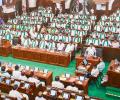
=In 21 states, the time gap between the general Budget and ministry-specific discussions was just one day.
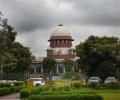
A five-judge Constitution bench of the Supreme Court is scheduled to consider the Presidential reference on whether timelines could be imposed by judicial orders for the exercise of discretion by the President while dealing with bills passed by state assemblies.
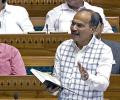
Congress leader Adhir Ranjan Chowdhury on Tuesday sought to give credit to his party for the women's reservation bill but Home Minister Amit Shah refuted his claim, saying that the legislation brought by the Manmohan Singh government had lapsed following the dissolution of the 15th Lok Sabha.

If the conflict continues for a prolonged period, State-run oil companies may have to review retail fuel prices accordingly.

A long-billed vulture, J132, released in Maharashtra's Pench Tiger Reserve, has travelled nearly 750 km in 17 days, reaching close to Anjaneri hills near Trimbakeshwar in Nashik district. The vulture's journey is part of a conservation program by the state forest department and the Bombay Natural History Society (BNHS).

Reserve Bank Governor Sanjay Malhotra on Friday said the key policy rates will remain at low levels for a long period and may go down even further.

The Supreme Court has questioned the practice of Governors withholding assent to bills indefinitely, stating that it renders the constitutional provision of 'as soon as possible' meaningless.
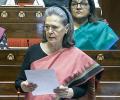
Congress Parliamentary Party chairperson Sonia Gandhi has criticized the Waqf (Amendment) Bill, calling it a 'brazen assault' on the Constitution and part of the BJP's strategy to keep society in a 'permanent state of polarization.' She also spoke out against the One Nation, One Election Bill, calling it a 'subversion of the Constitution.' Gandhi further accused the Modi government of ignoring the women's reservation bill and other demands for reservation, and of 'dragging the country into an abyss' where the Constitution will only exist on paper. She also criticized the government for limiting the speaking time of the Leader of the Opposition in Parliament and for not allowing discussions on important issues like the working of the defense and external affairs ministries and the challenges posed by China on the border.

From April 1, 2026, the Reserve Bank of India's new authentication directions modernise how every digital payment you make must be verified -- and place the burden of security squarely on your bank, not on you.

Indian refiners are negotiating for additional crude cargoes from the US, Russia, and West Africa to ensure adequate supplies amid Middle East tensions. Refineries are maintaining normal processing rates and deferring maintenance to build reserves. The move comes as conflict impacts tanker movements through the Strait of Hormuz, a key energy transit route.
